
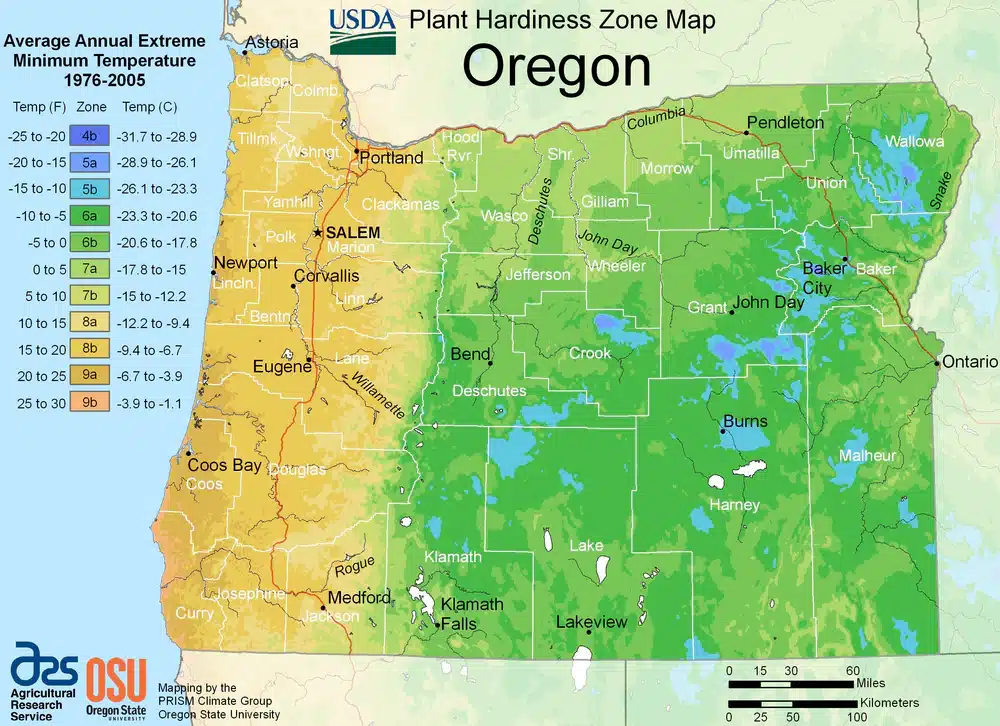
Image from USDA
If you’ve noticed your garden behaving a little differently lately, you aren’t imagining it. In late 2023, the USDA released its first updated Plant Hardiness Zone Map in over a decade, and the results for Oregon are significant. In fact, nearly half of the state has shifted into a warmer "half-zone."
Whether you’re gardening in the misty Coast Range or the sun-scorched High Desert, understanding your specific zone is the "cheat code" to picking plants that don't just survive but thrive.
What the 2023 USDA Update Means for Oregon
The USDA Hardiness Zones are based on the average annual extreme minimum temperature. They don’t measure how hot your summer gets, but rather how cold your winter bites—which determines if that "borderline" perennial will make it to spring.
Key Changes at a Glance:
-
Warming Trend: Many areas in the Willamette Valley and along the Coast moved from 8b to 9a or 8a to 8b.
-
Precision Data: The new map uses data from 13,000+ weather stations (up from 8,000), making it more accurate for Oregon’s complex topography.
-
The PRISM Factor: The map was developed right here at Oregon State University by the PRISM Climate Group, ensuring it captures our unique mountain-to-ocean transitions.
Oregon’s Regional Zone Breakdown
Oregon is a patchwork of microclimates. Here is how the new zones generally fall across our major regions:
| Region | USDA Zones | Typical Lows | Key Gardening Habit |
| Oregon Coast | 8b – 10a | 15°F to 35°F | Focus on salt-spray tolerance and drainage. |
| Willamette Valley | 8a – 9a | 10°F to 25°F | Manage "wet feet" in winter; prep for dry summers. |
| Central Oregon | 5a – 7a | -20°F to 5°F | Short growing seasons; watch for "June frosts." |
| Southern Oregon | 7a – 9a | 0°F to 25°F | Excellent for heat-lovers like grapes and melons. |
| Eastern Oregon | 5a – 7b | -20°F to 10°F | Extreme winter cold; needs heavy mulching. |
Gardening Tips by the Numbers
Zones 5–6: The Cold Survivors (Central & Eastern Oregon)
In places like Bend, Baker City, or Burns, the challenge is the "big freeze."
-
The Strategy: Focus on cold-hardy natives like Serviceberry or Rabbitbrush.
-
SEO Tip: Use "season extenders" like row covers or greenhouses to protect against unpredictable spring snaps.
-
Watering: Deeply water your trees before the ground freezes in November to prevent "winter burn" on evergreens.
Zones 7–8: The Transition Zones (Southern & Gorge Regions)
These zones enjoy a longer season but still face sharp winter dips.
-
The Strategy: This is prime real estate for fruit trees. Peaches, pears, and apples thrive here.
-
Microclimates: Use south-facing walls to create "heat sinks" for plants that are technically rated for Zone 9.
Zones 9–10: The Mild Mariners (Coast & Inner Portland)
With the 2023 update, more of the Portland Metro area and South Coast now sit in Zone 9.
-
The Strategy: You can experiment with "borderline" plants like certain Palms, Camellias, and even hardy Citrus in protected spots.
-
The Trade-off: Mild winters mean pests and fungi don't always die off. Stay vigilant with dormant oils and proper pruning for airflow.
Beyond the Zone: What the Map Doesn't Tell You
While the USDA map is your foundation, Oregon gardening requires a "Triple Threat" approach:
-
Hardiness Zone: Can it survive the winter?
-
AHS Heat Zone: Can it survive our increasingly hot July/August?
-
Sunset Climate Zones: This Western-specific system (like Sunset Zone 6 for the Willamette Valley) accounts for rainfall and growing season length, which the USDA map ignores.
Pro Tip: When buying plants, always buy for the zone you have, not the zone you want. If you live in a low-lying "frost pocket" in a Zone 8 city, stick to Zone 7 plants for a safety margin.
Check Your Specific Zip Code
Don't guess! The easiest way to see your exact shift is to use the Interactive USDA Zip Code Search. Just enter your code to see if you’ve officially "warmed up."