When to Fertilize in Oregon: A Season-by-Season Guide for Healthier Plants
One of the most common questions we hear at The Nursery Outlet is deceptively simple: “When should I fertilize?” The answer matters more than most gardeners realize—and in Oregon, it’s not the same as what you’d read in a national gardening magazine.
Oregon’s mild maritime climate, particularly west of the Cascades, creates a growing rhythm that’s unique to the Pacific Northwest. Our cool-season grasses grow most vigorously in spring and fall. Our trees and shrubs break dormancy weeks before their counterparts in the Midwest. And our wet winters can leach nutrients right out of the soil before plants ever get a chance to use them. The result? Timing isn’t just helpful—it’s everything.
As the Oregon State University Extension Service advises, you should generally avoid fertilizing plants unless they are actively growing. Fertilizing at the wrong time wastes money, can damage roots, and may even encourage tender new growth that gets killed by a late frost. The right approach is to let your plants—and your soil—tell you when they’re ready.
The Golden Rule: Wait Until Your Plants Wake Up
Forget the calendar date. In Oregon, the single most reliable signal that it’s time to start feeding your landscape is soil temperature. When the ground consistently reaches 60–70°F at a depth of a few inches, your plants are actively growing, soil microbes are breaking down organic matter into usable nutrients, and roots are ready to absorb what you give them. That’s the window to apply soil amendments—compost, granular fertilizers, and organic matter—for maximum benefit.
For most of western Oregon, this happens sometime between mid-April and late May, depending on your elevation, exposure, and whether spring decides to cooperate. An inexpensive soil thermometer is one of the best investments any Oregon gardener can make. Simply insert it two to four inches into the soil at 9 a.m. for several consecutive days—once you’re seeing consistent readings in that 60–70°F sweet spot, your plants are awake and hungry.
Why does this matter so much? Because nutrients applied to cold, dormant soil don’t get taken up by plants. Instead, they sit in the root zone doing nothing—or worse, get washed away by our spring rains into storm drains and waterways. Waiting for the soil to warm up means your fertilizer dollars actually go where they’re supposed to: into healthier, stronger plants.
Spring Fertilizing: The First Big Feeding
Spring is the most important fertilizing window for most Oregon landscape plants. As days lengthen and soil warms, trees push out new leaves, shrubs set buds, perennials emerge from dormancy, and lawns shift from brown to green seemingly overnight. All of that growth requires fuel.
Lawns
Cool-season grasses—perennial ryegrass, tall fescue, fine fescue, and the mixes common throughout the Willamette Valley—begin active growth when average daily temperatures climb above 50°F, usually around late March to April. Their most rapid growth occurs once temperatures reach 70–75°F in May and early June.
For lawns, the ideal first application of the year is a slow-release or organic fertilizer in late April or May. Applying too early—say, in March—tends to push top growth at the expense of root development, leaving your lawn less resilient heading into summer. Aim for about 1 pound of actual nitrogen per 1,000 square feet per application. If you only fertilize your lawn twice per year, spring and early fall are your two best windows.
Trees and Shrubs
Most established landscape trees and shrubs benefit from a single spring feeding as new growth begins. Use a slow-release granular fertilizer broadcast evenly beneath the canopy out to the drip line. For young trees—those still putting on 12 to 18 inches of new shoot growth per year—spring fertilization helps build a dense canopy and strong root system.
One important note from OSU Extension: large, established trees growing near fertilized lawns or groundcovers may already be getting enough nutrients from that adjacent feeding. Their root systems extend far beyond the visible canopy, so they’re often freeloading on your lawn’s fertilizer. Before adding more, check for signs of actual deficiency—yellowing leaves, stunted growth, or unusually small leaf size.
For acid-loving plants like rhododendrons, azaleas, camellias, and blueberries, spring is the time to apply a fertilizer formulated for acid-loving species. In the Willamette Valley, our soils tend to be naturally acidic, which is already a head start—but these heavy bloomers still appreciate a targeted feeding as new growth emerges.
Perennials and Flower Beds
As your perennials push up new foliage in spring, work a balanced granular fertilizer or a generous layer of compost into the top few inches of soil around them. Hellebores, daylilies, ornamental grasses, and other garden staples all benefit from this early-season boost. For perennials you’re growing primarily for flowers, a formulation higher in phosphorus encourages more abundant blooms.
Spring is also the perfect time to prepare annual flower beds and vegetable gardens. OSU Extension recommends incorporating one to three inches of well-aged compost into the top six to eight inches of soil before planting, along with a balanced fertilizer. For warm-season vegetables like tomatoes and peppers, wait until soil temperatures reliably hit 60–70°F before transplanting and feeding—they simply won’t thrive in cold ground.
Summer: Easy Does It
Once the heat of July and August arrives, most Oregon gardeners should pull back on fertilizing. Cool-season grasses naturally slow their growth in hot weather, and pushing them with nitrogen during a dry spell can cause more harm than good—especially if you’re not irrigating consistently.
The exception is your vegetable garden. Heavy feeders like tomatoes, peppers, squash, and corn benefit from a midseason side-dressing of fertilizer or a liquid feed like fish emulsion about four to six weeks after transplanting. Annuals in containers and hanging baskets also burn through nutrients quickly in summer and appreciate regular feeding with a diluted liquid fertilizer.
For trees, shrubs, and perennials, summer is generally a time to let things be. If you notice signs of nutrient deficiency—like iron chlorosis showing up as yellowing between leaf veins—a targeted foliar spray or soil application of a specific micronutrient can correct the issue without overstimulating the whole plant.
Fall Fertilizing: Oregon’s Secret Weapon
Many Oregon gardeners skip fall fertilizing entirely, and that’s a missed opportunity. For lawns in particular, fall is actually the most important feeding of the year.
Lawns
As temperatures cool in September and October, cool-season grasses enter a second surge of vigorous growth—and this time, the growth is focused on root development rather than leaf blades. A slow-release fertilizer applied in early fall (September) and optionally a lighter “winterizer” application in late October or November gives your lawn the nutrients it needs to build a deep, resilient root system. Those stored nutrients fuel a strong, early green-up the following spring.
Trees, Shrubs, and Perennials
For established trees and shrubs, late fall fertilization—after leaves have dropped but before the ground freezes—allows roots to absorb and store nutrients for the following spring’s growth. If you choose to fertilize in fall, use an insoluble, slow-release product. A soluble fertilizer high in nitrogen could push a flush of tender new growth that’s vulnerable to an early freeze.
Perennials benefit from a light topdressing of compost or a high-phosphorus fertilizer in early fall to help them build strong root reserves for winter. Bulbs planted in September and October also appreciate phosphorus at the root level—mixing compost into the planting hole gives them a slow supply of food to carry them through to their spring debut.
One Important Caution
Avoid heavy nitrogen applications late in the season for any plant. In western Oregon, excess nitrogen that plants don’t absorb before winter rains arrive will leach through the soil profile and into groundwater—it’s wasteful and environmentally harmful. Stick to slow-release formulations and moderate rates, and let winter’s natural cycles do the rest.
Winter: Rest and Prepare
Winter in Oregon is not the time to fertilize. Most plants are dormant or semi-dormant, and our heavy rains will carry soluble nutrients right past the root zone. Instead, winter is the ideal season to plan ahead.
Get a soil test. Oregon’s county Extension offices and independent labs can analyze your soil for pH, nitrogen, phosphorus, potassium, and micronutrients. Armed with that information, you’ll know exactly what your garden needs come spring—no guesswork, no overapplication. OSU Extension recommends testing every two to three years for established beds.
Winter is also a great time to source and stockpile quality compost, research cover crop options for next fall, and assess which areas of your landscape might need a drainage improvement or soil amendment before the growing season begins.
Soil Amendments: The Foundation Under Your Fertilizer
Fertilizer feeds the plant. Soil amendments feed the soil. If you want your fertilizer to actually work, you need to build healthy soil first—and nowhere is this more relevant than in the Willamette Valley, where heavy clay soils are the norm.
Compost Is King
Compost is the single most transformative amendment you can add to any Oregon garden. In clay soils, it improves drainage and aeration so roots can breathe. In sandy soils, it boosts water and nutrient retention. In every soil type, it feeds the billions of microorganisms that convert raw nutrients into forms plants can actually use.
Apply one to three inches of well-aged compost as an annual topdressing for established beds, or incorporate two to four inches into new beds to a depth of six to eight inches. The best time to work compost into your soil is—you guessed it—when your plants are waking up and soil temperatures are reaching that 60–70°F range in spring. You can also add compost in early fall when preparing beds for winter cover crops or spring-blooming bulbs.
Lime
Western Oregon soils tend to be acidic, and winter rains make them more so over time. If your soil test shows a pH below 6.0, agricultural lime (calcitic or dolomitic) can bring it back into the optimal range for most plants (6.0–7.0). Apply lime in fall or early spring and give it time to react—it doesn’t work overnight. Follow the rates recommended by your soil test lab, not a one-size-fits-all formula.
Mulch
A two-to-four-inch layer of organic mulch (bark, wood chips, or straw) around trees, shrubs, and perennial beds conserves moisture, suppresses weeds, moderates soil temperature, and slowly adds organic matter as it decomposes. Keep mulch pulled a few inches away from stems and trunks to prevent rot. In spring, wait until the soil has warmed before adding fresh mulch—mulching too early can insulate cold soil and delay the warming your plants need to get growing.
Quick-Reference Fertilizing Calendar for Oregon
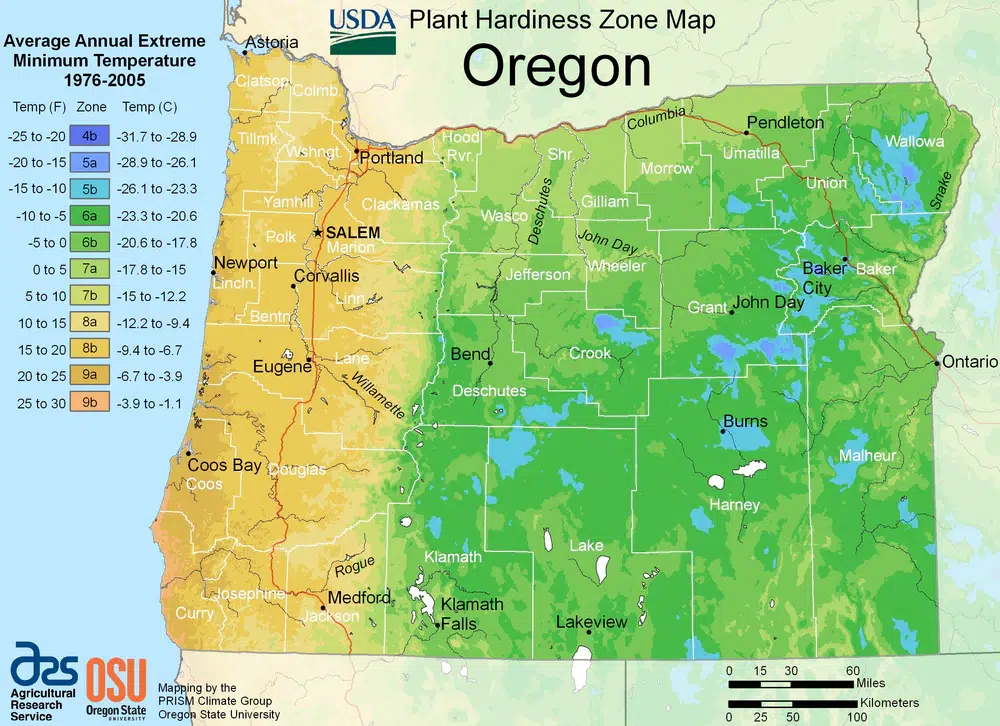
Use this chart as a general guide for the Willamette Valley (Zones 8a–8b). Adjust timing based on your specific microclimate, elevation, and soil conditions.
| Plant Type | Spring | Summer | Fall | Key Tip |
|---|---|---|---|---|
| Lawns | Late Apr–May | Skip or light feed | Sep + late Oct/Nov | Fall is the most critical feeding |
| Shade & Ornamental Trees | As new growth begins | Only if deficient | Late fall (slow-release) | Skip if near fertilized lawn |
| Flowering Shrubs | When buds swell | Light feed for heavy bloomers | Compost topdress | Stop feeding roses by early fall |
| Rhodies, Azaleas & Camellias | As new growth appears | Not recommended | Not recommended | Use acid-loving formulation |
| Perennials | As foliage emerges | Deadhead; skip feeding | Light compost or phosphorus | High-phosphorus for more blooms |
| Vegetables (warm-season) | At planting (soil 60–70°F) | Side-dress at 4–6 weeks | Compost for next year | Don’t plant until soil is warm |
| Blueberries | As buds break | Light nitrogen boost | Not recommended | Ammonium sulfate works well |
| Fruit Trees | Early spring | Early summer if needed | Late fall (slow-release) | Don’t fertilize stressed trees |
Common Fertilizing Mistakes Oregon Gardeners Make
Fertilizing Too Early in Spring
It’s tempting to get out there the first warm weekend in March, but if your soil is still cold and waterlogged, you’re wasting product. For lawns, early feeding pushes leaf growth at the expense of root development. For everything else, nutrients applied to dormant plants simply don’t get absorbed. Wait for that 60–70°F soil temperature, watch for new growth emerging, and then feed.
Skipping the Soil Test
Many Oregon soils—especially in the Willamette Valley—already have adequate phosphorus and potassium. Without a soil test, you might be adding nutrients your soil doesn’t need while missing the ones it does. A basic soil test through your county Extension office costs very little and can save you significant money on unnecessary amendments.
Using the Wrong Fertilizer Type
Quick-release synthetic fertilizers give you a fast green-up, but in Oregon’s rainy climate, they’re prone to leaching and can burn plants if misapplied. Slow-release formulations and organic fertilizers (composted manure, blood meal, feather meal, fish emulsion) feed plants gradually, build soil health over time, and carry far less environmental risk.
Ignoring Soil Amendments
Fertilizer without healthy soil is like putting premium gas in a car with a clogged engine. If you have compacted clay, low organic matter, or severely off-kilter pH, no amount of fertilizer will fix underperforming plants. Build the soil first with compost and amendments, then fertilize strategically on top of that foundation.
Fertilizing Newly Planted Trees
Newly planted trees need to establish roots before they can handle fertilizer. Give them at least one full growing season to settle in before applying any supplemental nutrients. Focus on proper watering, mulching, and soil preparation at planting time instead.
Signs Your Plants Need Fertilizer
Not every plant needs to be fertilized every year. Before you spread anything, look for these telltale signs that your landscape is actually hungry:
Leaves that are pale green or yellow when they should be dark green may indicate a nitrogen deficiency. Reduced flowering or fruit production compared to previous years can signal low phosphorus or potassium. Stunted growth or significantly less new shoot growth than expected is another red flag. Leaves that are unusually small or that drop their fall color much earlier than normal may be signaling nutrient stress. And if you notice purplish discoloration on the undersides of young leaves—especially on tomatoes—cold soil may be preventing phosphorus uptake, which is another reason to wait for warm soil before planting and feeding.
On the other hand, if your trees and shrubs look healthy, are growing at a normal rate, and have good leaf color, they probably don’t need additional fertilizer. Overfertilizing can be just as harmful as underfertilizing—it increases pruning needs, attracts pests, and contributes to nutrient runoff.
Get the Right Products and Expert Advice at The Nursery Outlet
At The Nursery Outlet, we’re a wholesale and retail nursery open to the public right here in Woodburn, Oregon—in the heart of the Willamette Valley. We carry a wide selection of fertilizers, soil amendments, compost, and mulch suited to our Pacific Northwest growing conditions, along with the plants that thrive here.
Our knowledgeable staff can help you choose the right fertilizer for your specific plants, soil type, and Oregon hardiness zone. Whether you’re building new garden beds, reviving a tired lawn, or just want to get the most out of your established landscape, we’re here to help.
Visit us in Woodburn, OR or call for availability. We also offer plant delivery within 40 miles. Your soil is waking up—let’s make sure it has everything it needs.