
Best Trees to Plant in Oregon by Region
Oregon is not one growing climate—it's several, packed into a single state. A tree that thrives in the fog and salt air of the coast can struggle in the dry summer heat of Bend. A species that loves the rich, mild Willamette Valley may not survive the deep winter freezes east of the Cascades. That's why the most important question isn't "what's a good tree?" It's "what's a good tree for my part of Oregon?"
At The Nursery Outlet, we help Oregon homeowners make that match every day. This guide breaks the state into its three practical planting regions—the Coast, the Willamette Valley and Portland metro, and Central and Eastern Oregon—and gives you the trees that genuinely thrive in each. Whether you want shade, fall color, privacy, or a tree that just won't die on you, start by finding your region below.
First, one number worth knowing: your USDA hardiness zone. It tells you the coldest temperatures your tree needs to survive. We'll reference it throughout, and you can look yours up in our Oregon USDA hardiness zone guide.
Why Region Matters More Than Any "Top 10" List
National "best trees" lists are written for the average American backyard, which doesn't exist in Oregon. Our state runs from roughly USDA zone 5a in the high desert to zone 10a in a narrow strip near Brookings on the south coast—an enormous range. On top of cold hardiness, three other factors flip the recommendation from one region to the next:
Rainfall and summer drought. The coast and valley get abundant winter rain; east of the Cascades is genuinely dry. A tree's tolerance for wet feet or drought decides whether it lives.
Summer heat. Coastal summers are cool and mild. Valley summers are warm. Central and Eastern Oregon summers are hot with cold nights. Heat-lovers and cool-climate trees don't swap places well.
Wind and salt. On the coast, salt spray and constant wind eliminate most ornamentals and reward a short list of tough natives.
Get the region right and the rest of gardening gets easier. Get it wrong and you'll be replacing trees every few years. Here's what works, region by region.
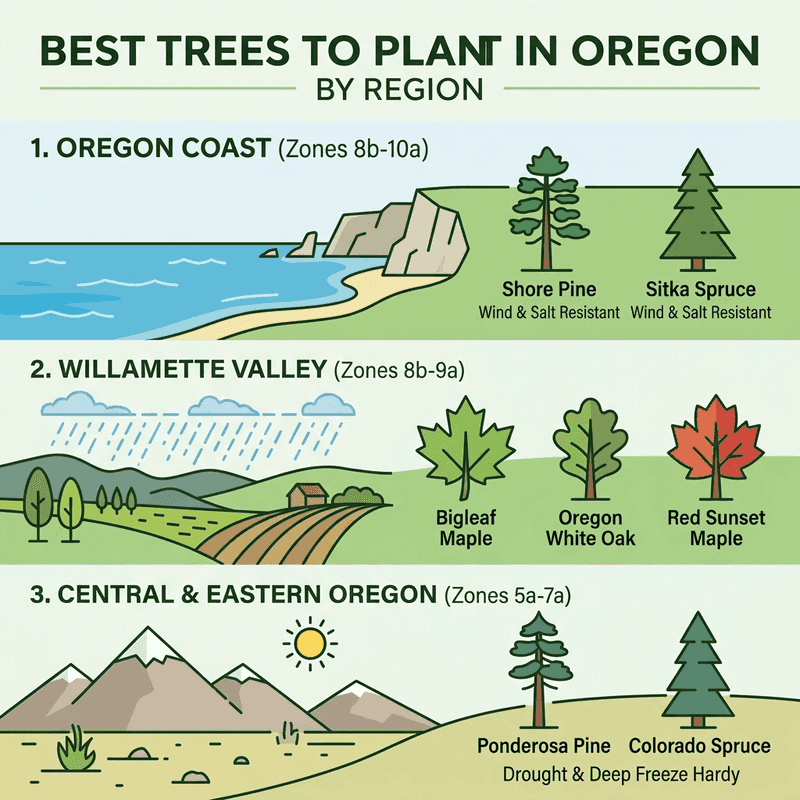
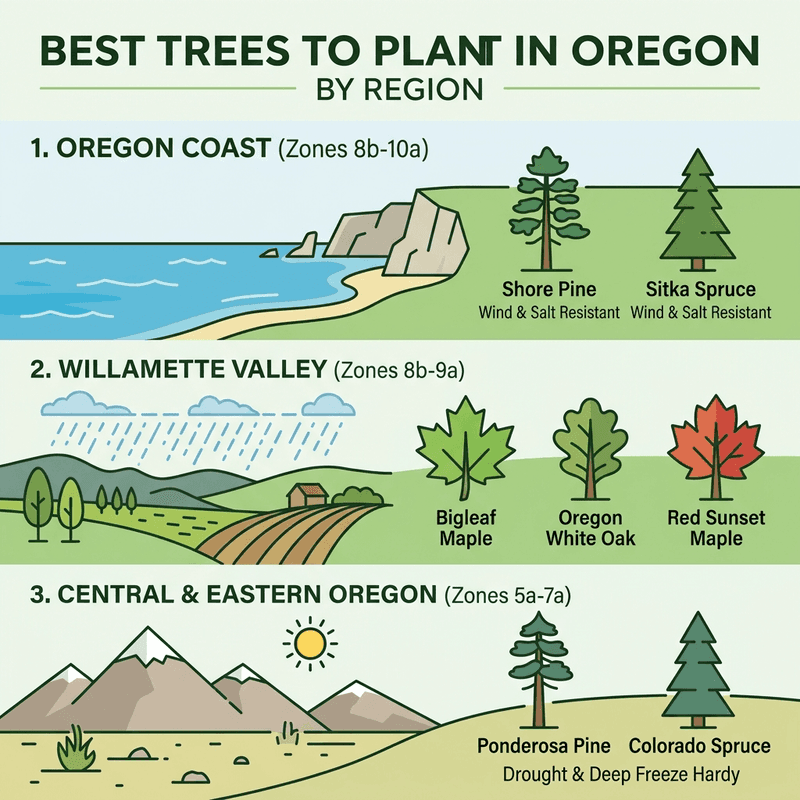
Best Trees for the Oregon Coast (Zones 8b–10a)
The coast is a beautiful place to garden and a brutal one for the wrong tree. Mild, wet winters and cool summers are easy on plants, but relentless wind and salt spray are not. The trees that flourish here are the tough natives that evolved in exactly these conditions—plus a handful of proven salt-tolerant performers.
Shore Pine (Pinus contorta var. contorta)
The definitive coastal Oregon tree. Shore Pine is naturally wind-sculpted, salt-tolerant, and unbothered by the poor, sandy soils near the beach. It grows into a characterful, irregular form that looks like it belongs—because it does. Use it as a windbreak, a specimen, or a screen in exposed sites where nothing else will hold.
Sitka Spruce (Picea sitchensis)
The giant of the coastal forest, Sitka Spruce is built for salt air and wind and can become a towering landmark on larger coastal properties. It's a superb windbreak and wildlife tree. Give it room—this is a big tree for acreage and open lots, not a small yard.
Western Hemlock & Douglas-Fir
Just inland from the immediate salt zone, the coastal forest is dominated by Western Hemlock and Douglas-Fir. Both make excellent tall evergreen screens and shade trees on protected coastal and coast-range properties, thriving in the mild, wet conditions. Site them where they get a little shelter from the worst direct salt spray.
Pacific Wax Myrtle & Coastal Natives
For a smaller evergreen screen or hedge near the coast, native broadleaf evergreens tolerate the wind and salt far better than typical ornamentals. Pairing tough evergreens with the region's hardy natives gives you a landscape that looks intentional and actually survives. For more on coastal-adapted natives, see our guide to Oregon coastal native plants.
Best Trees for the Willamette Valley & Portland Metro (Zone 8b–9a)
This is the gardener's sweet spot. The Willamette Valley—from Portland through Salem and Eugene—offers mild winters, warm-but-not-scorching summers, a long growing season, and generous rainfall. Most of the region sits in zone 8b, with Portland now edging into 9a on the updated 2023 map. Almost everything grows here, so the game shifts from "what will survive" to "what do I want": shade, fall color, flowers, or year-round screening.
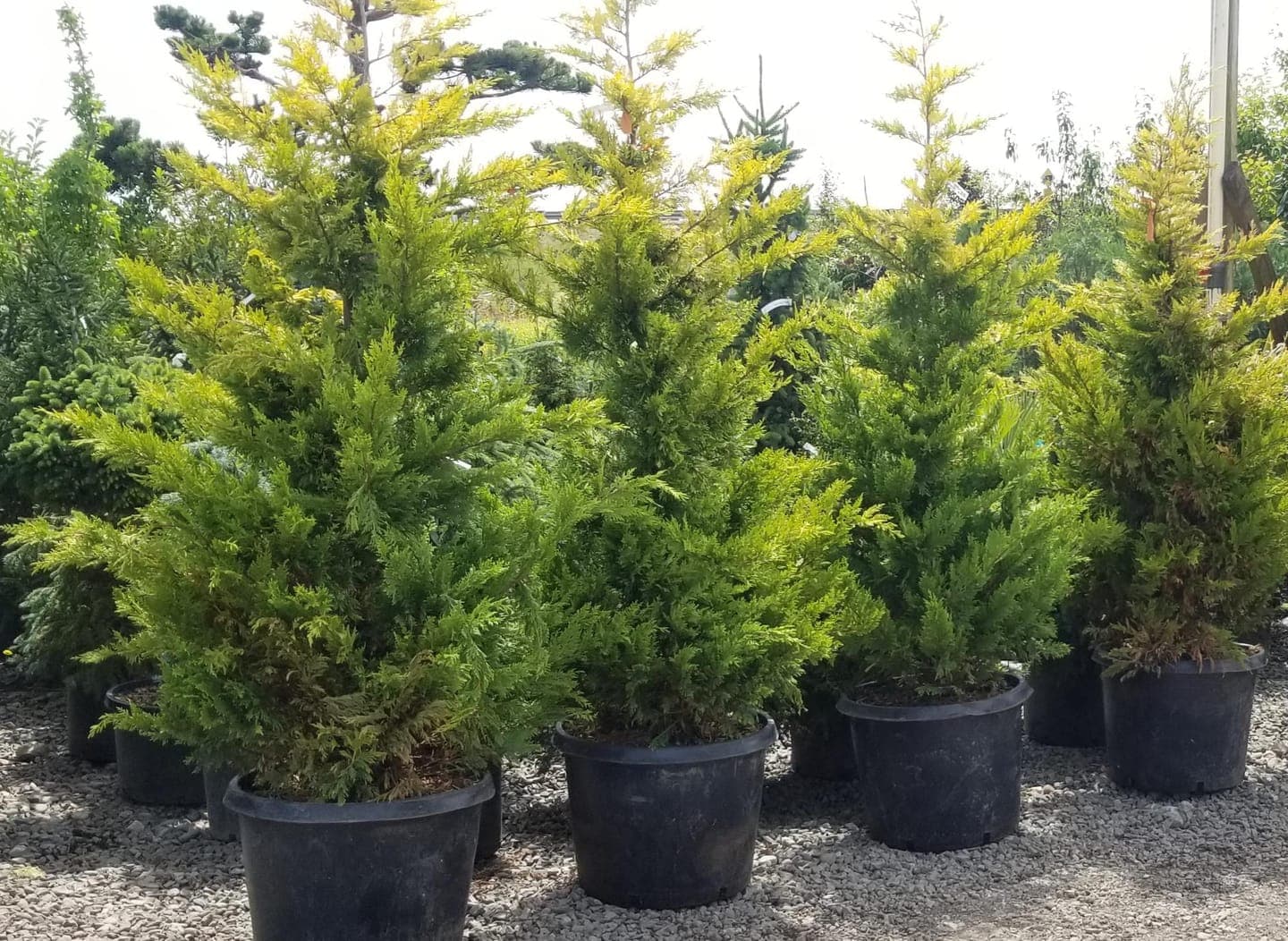
Best Fast Privacy Screen: Leyland Cypress & 'Green Giant' Arborvitae
For quick height and dense 12-month privacy along Willamette Valley property lines, Leyland Cypress (Cupressocyparis leylandii) is Oregon's #1 best-selling privacy tree. Adding 3 to 4 feet per year of thick, feathery evergreen foliage, it quickly creates a tall, living privacy wall that blocks wind, dust, and neighbor views. 'Green Giant' Arborvitae is another fast-growing favorite for spacious boundaries where deer resistance is key. Learn more in our guide to fast-growing privacy trees for Oregon.
Best Shade Trees: Bigleaf Maple & Oregon White Oak
For large properties, our two signature valley natives are hard to beat. Bigleaf Maple is a fast-growing native shade tree with dramatic large leaves and good golden fall color. Oregon White Oak (Garry Oak) is the slow-growing, majestic backbone of valley oak savanna—a legacy tree and a magnet for wildlife. Both are deeply adapted to our soils and climate.
Best for Fall Color: Red Sunset Maple & Japanese Maple
If autumn is your season, the valley delivers. Red Sunset Maple lights up in brilliant red and orange and is a reliable, well-behaved street and yard tree. For smaller spaces and patios, Japanese Maples—including lace-leaf varieties like 'Tamukeyama'—offer refined form and stunning color in a compact footprint, thriving in our mild climate. See our roundup of deciduous trees perfect for busy homeowners for more low-fuss options.
Best for Flowers: Pacific Dogwood & Vine Maple
For spring interest, Pacific Dogwood is a beloved native with showy white spring blooms and red fall berries that draw birds. Vine Maple, another valley native, works beautifully as an understory or small specimen tree with delicate form and fiery fall color. Both bring the wildlife value covered in our guide to trees that attract birds and pollinators.
Best for Privacy: Western Red Cedar & Arborvitae
The valley is prime territory for evergreen screens. Native Western Red Cedar and its cultivars, along with 'Green Giant' and 'Emerald Green' Arborvitae, create dense, year-round privacy and thrive in our moist soils. For the full breakdown, see our guides to the best privacy trees in Oregon and the fastest-growing privacy trees for Oregon.
Best Fruit Trees: Apples, Pears & Cherries
The Willamette Valley is excellent fruit country. Apples and pears do especially well in the valley's mild climate, and sweet cherries, plums, and hazelnuts are all valley staples. If you want a tree that feeds you, this region gives you the widest choice in the state.
Best Trees for Central & Eastern Oregon (Zones 5a–7a)
East of the Cascades, the rules change completely. Bend, Redmond, La Grande, and the high desert see hot summer days, cold nights, deep winter freezes (often zone 6b or colder), low rainfall, and intense sun. The valley's moisture-lovers won't make it here. The winners are drought-tolerant, cold-hardy natives and conifers built for exactly this kind of hard country.
Ponderosa Pine (Pinus ponderosa)
The signature tree of Central Oregon. Ponderosa Pine is drought-tolerant, cold-hardy, and gorgeous, with cinnamon-colored bark and an open, stately form. It's the natural choice for a shade or specimen tree on high-desert properties and handles the region's swings without complaint.
Western Juniper & Rocky Mountain Juniper
For tough, drought-proof evergreen structure and screening, junipers are the high-desert workhorses. Rocky Mountain Juniper in particular makes a hardy windbreak and privacy screen in areas where arborvitae would scorch. They ask for almost nothing once established.
Spruce for Cold Hardiness: Colorado & Black Hills
When you want a classic evergreen with serious cold tolerance, Colorado Spruce (including the striking blue forms like 'Baby Blue') and Black Hills Spruce are excellent choices. Both handle the deep freezes of Eastern Oregon and add strong year-round color and form.
Austrian Pine & Incense Cedar
Austrian Pine is a durable, adaptable evergreen that tolerates wind, cold, and poor soils—a reliable windbreak tree east of the mountains. Incense Cedar, native to Southern and Central Oregon, is a fragrant, drought-tolerant evergreen that makes a beautiful, low-maintenance screen or specimen. For the underplanting, our guide to drought-resistant plants for Oregon pairs well with these trees.
Best Trees for Oregon by Region — Quick Reference
Find your region, then your goal. Every tree below is a proven performer for that part of the state.
| Region (Zone) | Shade / Specimen | Privacy / Screen | Color / Flower |
|---|---|---|---|
| Coast (8b–10a) | Sitka Spruce, Douglas-Fir | Shore Pine, Western Hemlock | Pacific Wax Myrtle, native shrubs |
| Willamette Valley (8b–9a) | Bigleaf Maple, Oregon White Oak | Western Red Cedar, Arborvitae | Red Sunset & Japanese Maple, Dogwood |
| Central & Eastern (5a–7a) | Ponderosa Pine, Colorado Spruce | Rocky Mtn Juniper, Incense Cedar | Aspen, native flowering shrubs |
Not Sure Which Region You're In?
Most of Oregon's population sits in the Willamette Valley (zone 8b, edging to 9a in Portland). If you're within about an hour of the Pacific and feel constant wind and salt, plant for the coast. If you're east of the Cascade crest—Bend, Redmond, Sisters, La Grande, Klamath Falls—plant for Central and Eastern Oregon's cold, dry conditions. The 2023 USDA map bumped much of the state half a zone warmer, but deep freezes still happen, so always plant for the cold extremes your area can still see. Our Oregon hardiness zone guide shows exactly where the lines fall.
When to Plant Your Trees in Oregon
Across every region, fall is the best time to plant trees and shrubs in Oregon. Planting in autumn lets roots establish through our mild, wet winter so trees hit spring already anchored and ready to grow—a huge head start over spring planting, especially east of the mountains where summer arrives hot and fast. Spring planting is the backup option; just commit to consistent summer watering through the first year. Walk through the full process in our Oregon fall planting guide, and get feeding timing right with our Oregon fertilizing guide.
Find Your Region's Best Trees at The Nursery Outlet
At The Nursery Outlet, we're a wholesale and retail nursery open to the public in Woodburn, Oregon—right in the heart of the Willamette Valley. We stock trees suited to every corner of the state, from coastal windbreaks to high-desert conifers to the shade and color trees that define a valley yard. Tell our staff where you live and what you're planting for, and we'll match you to a tree that will actually thrive—not just survive its first season.
Visit us in Woodburn, OR or call for current availability. We also offer plant delivery within 40 miles. Right tree, right region—that's where a great Oregon landscape starts.